Uganda’s HIV Rate Stagnates At 5.9% As 150,000 Remain Unaware Of Status
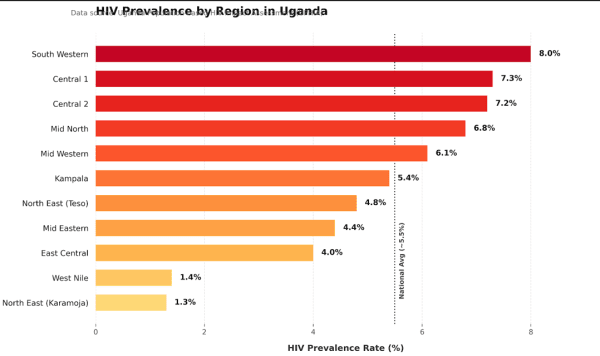
The region HIV prevalence in Uganda
Uganda’s HIV prevalence has remained largely unchanged since 2020, with health officials warning that about 150,000 people living with the virus do not know their status and remain outside treatment.
The preliminary findings of the 2025 Uganda Population-Based HIV Impact Assessment (UPHIA) put HIV prevalence among people aged 15 and above at 5.9 per cent.
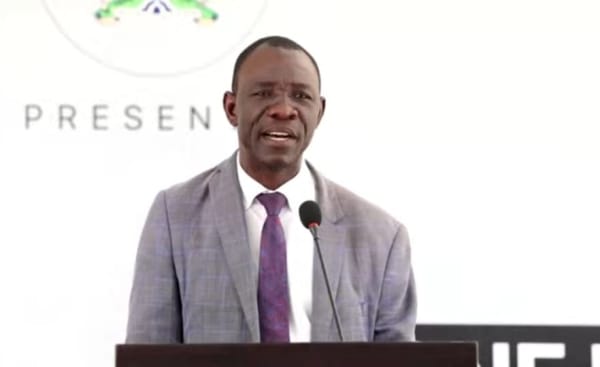
Health Minister Dr Chris Baryomunsi released the findings at the Uganda Media Centre on Thursday, October 1, 2026.
“The 5.9 per cent, while stable, is still high and should worry us as Ugandans,” Baryomunsi said.
The rate translates into an estimated 1.496 million adults living with HIV.
Women continue to carry a heavier burden. HIV prevalence among women stands at 7.3 per cent, compared with 4.1 per cent among men.
The study was conducted between July and September 2025 by the Ministry of Health in partnership with Makerere University School of Public Health, Uganda Bureau of Statistics, Uganda Virus Research Institute, regional referral hospitals, districts and other partners.
The US President's Emergency Plan for AIDS Relief funded the survey through the US Centers for Disease Control and Prevention.
Of the 6,283 eligible households, 94.4 per cent participated.
150,000 do not know their status
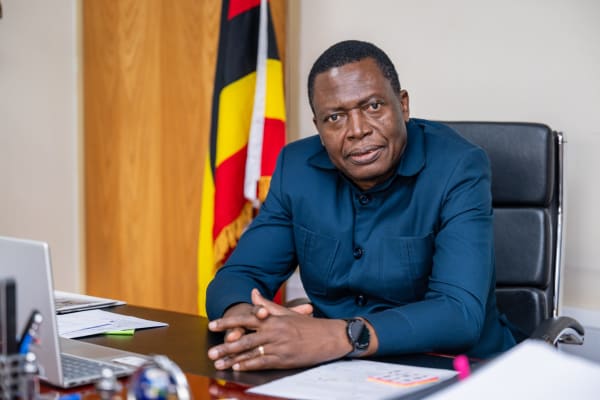
Ministry of Health Permanent Secretary Dr Diana Atwine said the findings give the government a clearer picture of where Uganda needs to strengthen its HIV response.
“We normally take these surveys to give us the status of our implementation on how far we have gone, but also a clear direction on where we need to put our emphasis as far as prevention and control is concerned,” Atwine said.
She said about 150,000 HIV-positive Ugandans do not know their status and have not started antiretroviral therapy (ART).
“We know that we have about 150,000 who are HIV positive and don't know their status, and they are not yet on ART, and that becomes the centre of the infection,” Atwine said.
Uganda is pursuing the 95-95-95 HIV targets. These seek to have 95 per cent of people living with HIV know their status, 95 per cent of those diagnosed receive treatment, and 95 per cent of those on treatment achieve viral suppression.
Atwine said the latest findings would help health authorities identify and reach people who remain outside treatment.
The survey found that HIV prevalence was lowest among adolescents aged 15 to 19.
Among men, prevalence peaked at 11.7 per cent among those aged 45 to 49.
Women aged 40 to 44 recorded a much higher peak of 15.7 per cent.
The burden also varies sharply across the country.
South Western Uganda recorded the highest regional prevalence at 8 per cent. Central 1, comprising Wakiso, Mpigi and Greater Masaka, followed at 7.3 per cent, while Central 2, covering Greater Mubende, Luwero and Mukono, stood at 7.2 per cent.
Mid North registered 6.8 per cent, followed by Mid Western at 6.1 per cent and Kampala at 5.4 per cent.
Teso recorded 4.8 per cent, Mid Eastern 4.4 per cent and Busoga 4 per cent.
West Nile and Karamoja recorded the lowest rates at 1.4 per cent and 1.3 per cent, respectively.
Baryomunsi said the final UPHIA report will provide more detail on the factors behind the differences between regions.
“We have to interrogate the findings and explain why the prevalence rates are as high as this,” he said. “The final report will bring out the details.”