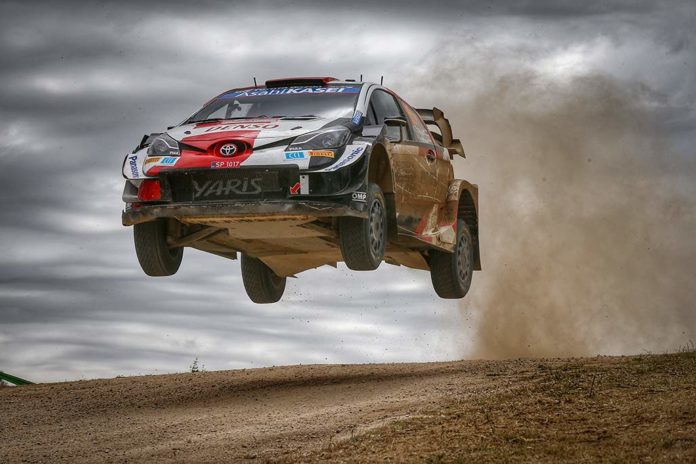
The Safari Rally is one of the toughest car races in the world and the 2021 edition staged 19 years after the last under the World Rally Championship calendar cemented the race’s reputation.
And who better to explain that than Belgian Thierry Neuville and eventual winner and reigning world champion Sebastien Ogier of France.
Belgian Neuville, co-driven by compatriot Martijn Wydaeghe in a Hyundai i20 Coupe had looked headed for victory on Sunday having built 57-secod lead on Saturday only to exit the Safari Rally crestfallen after breaking their rear suspension.

Uganda too was well represented with four teams, which however, due to technical frustrations, had be reclassified. Ronald Sebuguzi, Duncan Mubiru, Kepher Walubi and Hassan Alwi, who had hoped to debut in the World Rally Championship were instead put into the Kenya National Rally Championship (KNRC) where they competed against other Kenyan crews.
Fortunately, after the four-day event, two of the Ugandan drivers, Duncan Mubiru and Omar Mayanja dominated the KNRC.
Ronald Sebuguzi and Anthony Mugambwa finished second to secure a 1-2 for the frantic Ugandan team.
Kepher Walubi and Siraj Kyambadde finished fourth behind Kenya’s Izharph Mirza.
“I am so happy for this organisation. We were not treated any different regardless of being under national category. We took on same ceremonial podium, same stage and same final podium,” Walubi told The Brink News.
“The treatment made me forget were I wanted to be. And it was a big reason to start preparing earlier for next season,” he added.
Back at the World Safari Rally, Kenya’s Onkar Rai was busy giving his mates a run for their money.
The Kenyan champion simply said; “They asked for Safari Rally, they got Safari Rally.”

The statement by Onkar, who finished as the top Kenyan in seventh place, echoed throughout the bushes in the challenging terrain made up volcanic dust and rocks under the sand and strewn above the surface.
Japan’s Takamoto Katsuta best summed up what he called the African adventure when he described Saturday’s battle where out of nowhere, there was flash rains that forced Estonian Otto Tanak to stop and wipe his windshield.
It was a complete contrast of what Katsuta encountered on Friday where he admitted: “I had never used wipers without rain.”
And so, Saturday’s flash rain thrust a new challenge to the Japanese youngster when he exclaimed: “Big, big water, everywhere water, like standing water. You’re just avoiding and you don’t know where you are, it was quite crazy.”

Katsuta’s anxiety fed perfectly to the warning in WRC website which aptly summarized what awaited the European speedsters.
“The Safari of old has evolved to fit the modern-day WRC, but its character remains with challenging closed dirt roads, stunning picture-postcard scenery and exotic wildlife. Competitors can expect rocky and rutted tracks and unpredictable weather which could transform dry and dusty trails into glutinous mud baths.”
Poignantly, the unpredictable roads was only one element of the famed Safari Rally as Neuville said in Naivasha.
The unlucky Belgian had pointed out that the Safari is about ‘the roads, unpredictable weather and wildlife.” Incredibly, it was the tough roads that tossed him out.

“We knew it would be challenging. We saw several wildlife crossing the road, but we could not do anything about it. It is part of the Safari,” Neuville said.
The build up to the Kenyan leg of the WRC challenge created a buzz of unprecedented proportions both locally and abroad.
Naivasha, which hosted the 2021 Safari Rally in the scenic Great Rift valley, was a melting pot as it welcomed thousands of revelers most of them a younger generation that had only heard of the event from folklore retold.
The Safari Rally of the years gone covered over 1000km of competitive stages. The 2002 edition was staged 1010km which was then considered more of an endurance event than sprint as it is today.
In comparison, Safari Rally 2021 has only 320.19km (198.96 miles) in total, spread over 10 venues in Naivasha and totaling 18 specials stages. Great Britain’s Gus Greensmith said never before the Safari Rally had he cared to “manage his car”.
“The Safari Rally, however, has taught me that there comes a time when I have to manage the car and bring it home in one piece. The Safari Rally ranks as one of the top three I have competed in,” said the Briton who gave up goalkeeping at Manchester City to dive into rallying.
In the end, however, many drivers were already looking forward to the next edition