Uganda’s Youth Problem Framed as an Opportunity
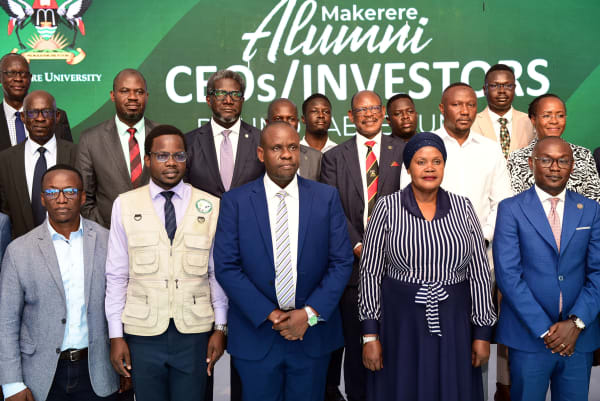
Stanbic Bank Executive Director, Samuel Fredrick Mwogeza (3L) second row, Makerere University Vice-chancellor, Barnabas Nawangwe (3R) second row, Balaam Barugahara, the Minister of State for Youth and Children Affai
The conversation on Africa’s future took centre stage at the Investor Roundtable Summit in Kampala, an event hosted by the Makerere University Alumni Association.
Under the theme, “Exploring Opportunities for Entrepreneurship, Innovation and Value Creation for Accelerated Socio-Economic Integration and Development of Sub-Saharan Africa,” the summit brought together a cross-section of alumni, investors, scholars, entrepreneurs, and policymakers. A highlight of the day was a powerful contribution from Samuel Mwogeza, Executive Director and Head of Personal & Private Banking at Stanbic Bank Uganda.
From Ticking Time Bomb to Demographic Dividend
Speaking to a packed audience, Mwogeza offered a frank and data-driven reflection on the youth unemployment crisis, a major challenge in Uganda. “Uganda has one of the youngest populations in the world—with over 77% under the age of 25,” he noted. “But what should be a demographic dividend is becoming a ticking time bomb. Over 4 million young people are not in school, not working, and not in training. We cannot afford to waste this talent.”
Mwogeza framed the moment as a defining opportunity to reimagine how African economies can create value, advocating for intentional investment in entrepreneurship, innovation, and inclusive financing. His words resonated with the young professionals and seasoned alumni in attendance, shifting the narrative from a crisis to a blueprint for progress.
The Private Sector as a Catalyst for Change
Drawing from Stanbic Bank Uganda’s initiatives, Mwogeza highlighted real examples of how the private sector can be a catalyst for change. He spotlighted the Stanbic National Schools’ Championship, an initiative that has equipped thousands of high school students with entrepreneurial skills, aiming to shift their mindsets from job-seeking to job-creating.
He also brought attention to the Stanbic Business Incubator, which provides enterprise development support to youth- and women-led small businesses in key sectors like agriculture, oil & gas, and services. A key barrier to entrepreneurship remains financing, and Mwogeza emphasised the bank’s efforts to bridge this gap. He mentioned the Stanbic for Her initiative, which has supported over 30,000 women entrepreneurs, and the Stanbic SACCO Programme, which provides low-interest financing to smallholder farmers to help them scale production.
A Bold Financial Commitment
Mwogeza concluded his address with a strong financial commitment. “Our current investment in local enterprises stands at over UGX 960 billion,” he shared. “But we are not stopping there.” He reaffirmed the bank’s pledge to channel up to UGX 1 trillion by 2028 toward enterprises led by women, youth, and farmers. “This is how we live our purpose—Uganda is our home; we drive her growth. It’s not just a slogan. It’s our strategy.”
The summit served as a powerful reminder that economic transformation is not only possible but urgent. It will require the public and private sectors to work hand in hand to create a more integrated and productive future. Voices like Mwogeza's are helping to shape that blueprint, one bold investment at a time.