Uganda Renews Ties with Brazil to Boost Trade and Aviation
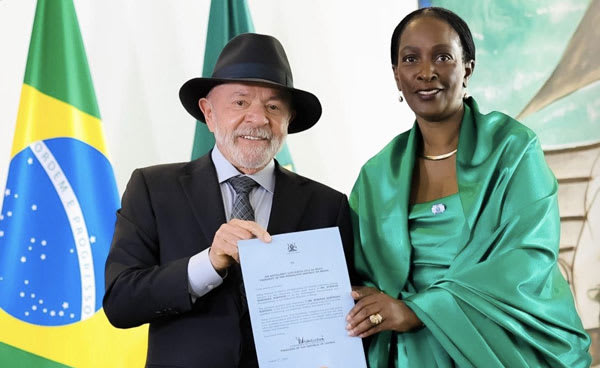
At the Itamaraty Palace in Brasília, Kakonge presented Letters of Credence to President Luiz Inácio Lula da Silva as the non-resident ambassador of the Republic of Uganda to the Federative Republic of Brazil.
Uganda has renewed its diplomatic engagement with Brazil, appointing Ambassador Robie Kakonge as its non-resident envoy.
The move signals Kampala’s growing appetite to broaden economic partnerships beyond traditional Western allies, focusing heavily on the Global South.
Announcing the development on X following her presentation of credentials to Brazilian President Luiz Inácio Lula da Silva, Kakonge—who is also Uganda’s ambassador to the United States—expressed readiness to strengthen bilateral cooperation.
While diplomatic relations date back to 1969, the partnership has historically remained underdeveloped. Kakonge’s appointment seeks to inject fresh momentum into a relationship with immense untapped potential.
Brazil, the world’s ninth-largest economy and a founding BRICS member, offers crucial expertise that aligns with Uganda's domestic growth priorities.
As an agricultural powerhouse, Brazil’s advancements in mechanization and climate-resilient farming present valuable value-addition lessons for Uganda’s coffee sector, Africa’s second-largest. Furthermore, Brazil’s Embraer, the world’s third-largest commercial aircraft manufacturer, opens doors for collaboration in aerospace manufacturing, pilot training, and aircraft maintenance as Uganda Airlines aggressively expands its ecosystem.
This diplomatic push coincides with Uganda’s growing integration into new geopolitical blocs, having officially become a BRICS Partner State. The alignment was further solidified when Vice President Jessica Alupo represented President Yoweri Museveni at the BRICS Summit in Rio de Janeiro.
By casting a wider diplomatic net that now spans from Beijing and New Delhi to Abu Dhabi, Ankara, and Brasília, Uganda is embracing a values-neutral, transactional foreign policy. Moving forward, Kampala's primary challenge will be translating this newfound diplomatic goodwill into tangible domestic economic growth.