Uganda Begins Construction Of Mpigi Fuel Terminal To Guard Against Supply Shocks
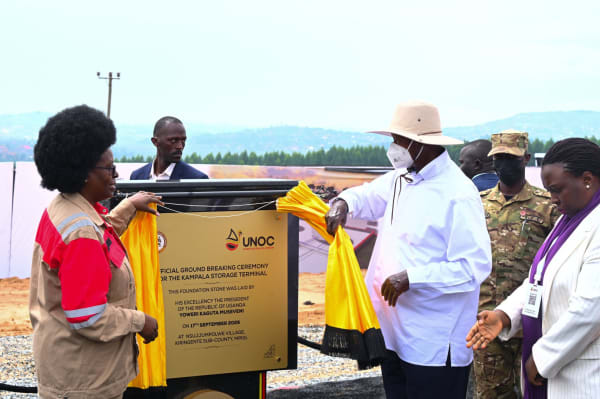
President Yoweri Museveni has broken ground for a 320-million-litre petroleum storage terminal in Mpigi District
President Yoweri Museveni has broken ground for a 320-million-litre petroleum storage terminal in Mpigi District as Uganda seeks to protect its fuel supply from global disruptions.
The Uganda National Oil Company (UNOC) will operate the Kampala Storage Terminal, which is expected to increase the government’s fuel reserves and support the country’s expanding petroleum network.
Museveni presided over the ceremony marking the start of construction.
Energy and Mineral Development minister Monica Musenero said the project would strengthen Uganda’s energy security and provide protection against international supply disruptions, market shocks and other emergencies.
“It will secure our energy security as a nation. It is going to be a strategic positioning project for the country,” Musenero said.
Uganda currently has a 30-million-litre government storage facility in Jinja. Work is underway to add another 10 million litres at the site.
The Mpigi terminal will raise the two facilities’ combined capacity to 360 million litres when completed.
Uganda consumes about 240 million litres of petroleum products each month. The new terminal could therefore hold more than one month’s national supply.
Musenero said the government acquired land for the project in 2008 after fuel demand increased.
The terminal forms part of a petroleum infrastructure plan developed in 2017. It was designed to support several proposed pipelines connecting Uganda to neighbouring countries and its planned refinery.
The Mpigi facility is expected to serve as a delivery point for the proposed Eldoret-Kampala petroleum pipeline extension. It will also support the proposed Kampala-Kigali pipeline and the Hoima-Buloba pipeline.
The Hoima-Buloba pipeline will transport petroleum products from Uganda’s planned refinery in Hoima to the terminal. Musenero said refinery construction was expected to begin next year.
She added that the terminal would allow UNOC to manage its commercial fuel stocks while helping the government build strategic reserves.
“It will give us a buffer against international supply disruptions, market shocks and other emergencies,” Musenero said.
Museveni welcomed the investment but argued that the planned capacity remained too small for Uganda’s long-term needs.
He criticised the government’s previous dependence on petroleum middlemen in Kenya and blamed slow action by public officials.
“Sleeping has been a big problem in Africa. In this sector, there was a lot of sleeping,” Museveni said.
He said a Kenyan senator alerted him that Uganda was buying petroleum products through middlemen.
“I called the then minister, Irene Muloni, and told her this was a disaster. She did nothing until later, when we linked up with refineries and started getting our own fuel,” Museveni said.
Uganda later changed its import system and authorised UNOC to purchase fuel directly for supply to local oil marketing companies.
“We are now moving slowly out of sleep,” Museveni said.
He noted that Uganda consumes 240 million litres of petroleum products each month, yet the government has relied on the 30-million-litre facility in Jinja.
Although the Mpigi terminal could cover national demand for more than a month, Museveni said Uganda needed enough reserves to withstand longer emergencies.
“This one here will be 320 million litres, which should secure us for a month plus. People are happy, but I see that this is not how a country should be run,” he said.