
UDB Reinforces Uganda’s Commitment to Climate Action
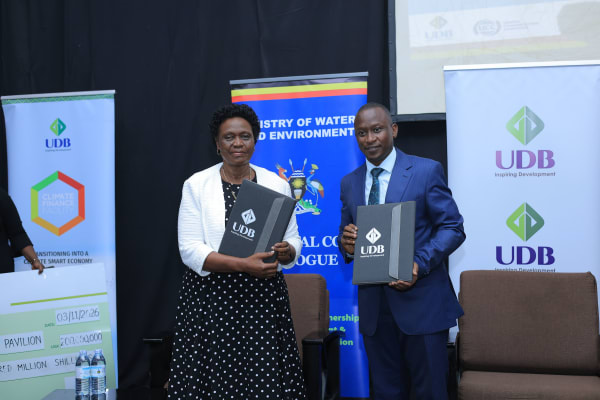
Minister of State for Environment, Hon. Beatrice Anywar (L) poses with UDB's Director Economic Research and Knowledge Management, Dr Francis Mwesigye after the MoU signing
Uganda Development Bank Limited (UDB), the country’s national Development Finance Institution (DFI), continues to reinforce its commitment to advancing Uganda’s climate action and sustainable development agenda through strategic engagement at the Conference of the Parties (COP).
Building on its sustained efforts to mobilise climate finance, the Bank is strengthening partnerships, unlocking green investment opportunities, and accelerating financing for commercially viable, climate-resilient projects across priority sectors of the economy.
The announcement was made today during the Pre-COP31 National Forum held at Silver Spring Hotel in Kampala. The Forum brought together government agencies, development partners, civil society and private sector players to collectively reflect on Uganda's climate ambitions and chart a strategic course towards meaningful engagement at COP31.
The 31st United Nations Climate Change Conference (COP31) will be held in Antalya in Türkiye from November 9 to November 20, 2026. At the summit, world leaders, experts, and civil society representatives will discuss joint solutions to combat climate change and build a sustainable future.
Speaking at the Pre-COP31 National Forum, the Minister of State for Environment, Hon. Beatrice Anywar said Tuesday’s Forum was a key opportunity for consolidating Uganda's priorities in the seven key negotiation areas; adaptation (including loss and damage), mitigation, climate finance, technology, capacity building, gender and compliance.
“Our goal is to agree on a common position and approach that reflects the priorities and aspiration of our people as we respond to the existing threats of climate change. Uganda is an agricultural country and our farmers need reliable water sources in the face of perennial drought and they also need a predictable, reliable weather forecast,” Hon. Anywar said.
The Minister who is leading the Ugandan delegation at COP31 said; “Uganda will continue to advocate for adequate, predictable, and accessible finance with particular emphasis on grant-based support for adaptation and the needs of the least developed countries Our ministries, agencies, local governments, and partners must work together to prepare a credible proposal, identify financing opportunities, and account for the results.”
The Minister also announced that Uganda’s deliberations and engagements at COP31 will be coordinated under the Uganda Pavillion which she said will provide a platform to build mutually beneficial partnerships and network for climate action. Uganda Development Bank has this year supported the Uganda Pavilion as lead sponsor with UGX 200 million.
Dr. Francis Mwesigye, the Director Economic Research and Knowledge Management at UDB who represented the Managing Director, Dr. Patricia Ojangole at the Forum said the sponsorship represents a strategic investment in elevating Uganda's voice within the global climate discourse, showcasing the country's climate investment potential and strengthening partnerships capable of translating climate commitments into tangible development outcomes.
“UDB has taken deliberate institutional steps to position climate finance as a central pillar of its development financing mandate. A key milestone in this journey has been the establishment of a dedicated Climate Finance Facility (CFF) and Climate Finance Unit, providing the institutional architecture necessary to coordinate, structure and scale the Bank's green financing interventions,” Dr. Mwesigye said.
“I'm happy to note that COP has been one of the key platforms that the Bank has used to mobilize this money. And since we started attending COPs, the Bank has mobilized not less than USD 200 million to capitalize this Climate Finance Facility.”
Through the CFF, the Bank seeks to strengthen its capacity to identify and vote bankable climate investments, provide technical guidance on appropriate financing structures, assess climate-related risks and opportunities, and support the implementation of investment that contributes to emission reduction, climate adaptation, and economic resilience.
At COP31, the Bank will host three strategic side events at COP31, designed to stimulate high-level dialogue, showcase investment opportunities and catalyse partnerships for financing Uganda's climate transition.
The first theme ‘From Climate Commitments to Financing Bankable Projects: Mobilizing Green Finance Using Market-Based Instruments’ will demonstrate how development finance institutions can serve as catalysts in translating national climate ambitions into commercially viable, investment-ready projects. The second event will be themed ‘Financing Decarbonization of the Transport Sector: The Case of E-Buses, E-Bikes, and Charging Infrastructure’ with an aim to position sustainable transport not only as a climate mitigation priority, but also as a strategic opportunity for industrial development, enterprise growth and economic competitiveness.
The other side event will be anchored on ‘Blended Finance for Climate Adaptation: From Large-Scale Irrigation Infrastructure to Last-Mile Connection’ in a bid to advance practical financing solutions that strengthen agricultural productivity, enhance food security, build climate resilience and promote inclusive economic transformation.
During the Pre-COP31 National Forum, UDB signed a Memorandum of Understanding (MOU) to formalize the partnership that will among other things promote Uganda’s investment opportunities by highlighting bankable, climate-aligned projects in renewable energy, climate-smart agriculture, sustainable infrastructure, and green manufacturing.
COP31 will mark the fourth year in a row that UDB is participating in the annual UN Climate Conference (COP) and the second year the Bank is lead sponsor of the Ugandan Pavilion.
Uganda’s forest cover reduced from 24% in 1990 to 9% in 2015 despite the slight step up to 12.4% currently, while wetland coverage is at 8.9% down from 13%. The World Economic Forum Report (2020) presents these as top global risks that will affect the world economies.