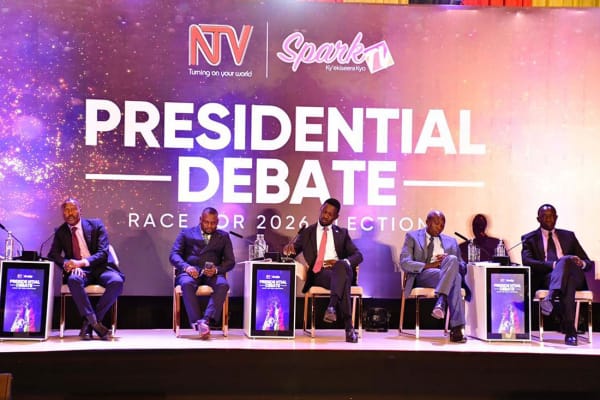
The Victoria Hall at the Serena Hotel was the scene of an unprecedented political spectacle last Sunday as five of Uganda’s presidential hopefuls engaged in a rigorous debate, the first of the campaign cycle, with only 46 days remaining until the high-stakes 15th January 2026 general election.
The atmosphere was heightened by the absence of the long-serving incumbent, President Yoweri Museveni.
Thesetting and format ensured a focused, if incomplete, dissection of the nation’s political landscape.
The candidates, including seasoned politician Mugisha Muntu Oyera, who was the first to arrive at 6:30 PM, sat shoulder-to-shoulder at the podium, deliberately placed no more than one metre apart, underscoring the direct nature of the challenge they represented.
The debate, broadcast and streamed live by NTV Uganda and its sister outlets, featured real-time fact-checking, a first for a Ugandan presidential forum.
Moderated by anchors Arnold Ssegawa and Priscilla Nalwoga Regina, this mechanism instantly elevated the expectation for substantive, evidence-based policy discussion, severely limiting the candidates’ reliance on unsubstantiated claims.
Over the course of the three-hour event, the five sparring candidates—excluding President Museveni and two fringe contenders—systematically tackled four pivotal areas: finance and economic growth, health and education, security and governance, and infrastructure development.
With each participant allocated a constrained four minutes and 30 seconds for initial presentation and a mere 30 seconds for rebuttals, the format forced concise, high-impact arguments.
Opposition leader Bobi Wine, whose prior confirmation had significantly ramped up public anticipation, used the platform to present an alternative vision, while figures like Muntu offered a contrasting perspective based on institutional reform and measured development. The absence of the NRM candidate meant that the focus remained sharply on the opposition’s ability to offer viable, coherent alternative governing strategies.
President Museveni’s refusal to participate, attributed by his team to prior electoral commitments, hung over the proceedings. The NRM’s decision to counter-programme the event by airing a pre-recorded “Gen Z podcast” simultaneously on the state broadcaster, UBC, from around 9:00 PM, only served to amplify the political divide.
While the podcast was marketed as an attempt to 'appreciate the lighter side' of the President, the debate continued, undeterred, with the candidates capitalising on the airtime to argue that the incumbent was avoiding direct accountability and policy scrutiny. Recognising the success and high engagement of the initial debate, Nation Media Group late Sunday night announced plans to host a second debate, hoping to eventually secure the participation of all eight final candidates.