In November 2017, while in Ouagadougou, Burkina Faso, the President of France, Emmanuel Macron gave a policy speech which captured six key areas: Making Education a priority; Supporting Entrepreneurship and Innovation; Promoting culture, the medium for a new common imagination; Better addressing climate change challenges; Promoting more partnership-based development; Supporting Africa, a partner of our collective security.
These six key areas are what will form the foundation of the discussions that will happen in the coming Africa-France New Summit [NSAF] to be held in Montpellier, France, from 7-9 October 2021.

Cognizant of the fact that a total of 2.5 billion people is expected to live in Africa by 2050, education becomes a critical component in the development cycle, because the population challenge has to be met over the long term. Education also plays an instrumental role in boosting economic growth and fighting inequalities. It’s against this notion, that France announced that it was increasing its contribution to the Global Partnership for Education tenfold and was significantly scaling up its efforts regarding primary education.

In his speech, President Macron further noted that € 2.5 billion was to be invested from 2018 to 2022, specifically to support young and innovative African businesses. Other projects such as the Social Inclusive Business Camp [SIBC], Digital Africa and the annual issuance of 1,000 “talent passports” to Africa, support this commitment. Macron also acknowledged that building a new common imagination means learning to look at the world and understand it from an African point of view.

It is also prudent to note that the environment and climate change are issues of interest, if we’re to register development, but in a sustainable sense. In its relations with Africa, France is looking forward to integrating sustainability in the development cycle. The pilot programmes of the International Solar Alliance, in the Abidjan metro project are reflective of this.

In 2019, France increased its official development assistance by € 1 billion. 50% of the AFD’s are conducted in Africa and 80% of its funds are allocated to Africa. This move was/is aimed at fostering more partnership-based development, with keen interest in young people.

In addition, France renewed its commitment to promote African responses to the challenges posed by terrorism, conflicts and organized crime. To that end, support was, and continues to be extended towards African peace operations, alongside the African Union, and through the G5 Sahel Joint Force, where five countries conduct operations to fight terrorism.
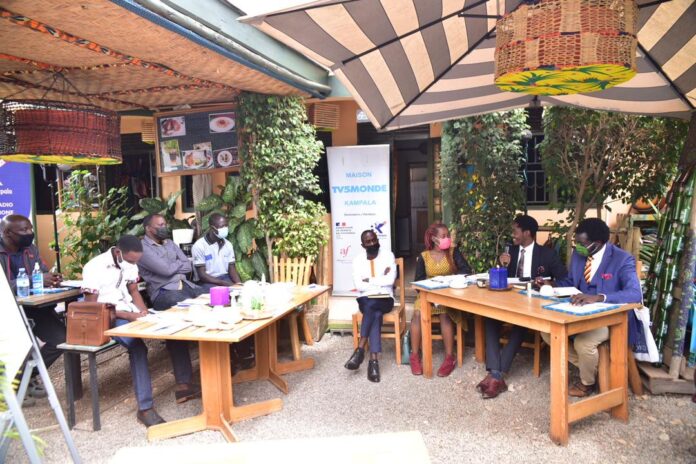
It is against this background that the French Embassy in Uganda organized debates and dialogues, which lasted six days. Under the themes of Culture; Knowledge; Governance; Gender Equality; Sports & Development; Business & Innovation; Health; Mobility; Stop Filming Us; Biodiversity & Climate; Media, these dialogues sought to delve into the intricacies of the Africa-France linkages so as to examine how Africa can leverage these relations and register growth in various sectors, without compromising its values and interests.

Panels consisting of experienced and knowledgeable figures around the country were organized, and the dialogues took course. Some notable names are Pheona Wall, Nicholas Opiyo, Samson Kasumba, Raymond Mujuni, Hon. Moses Magogo, Patrick Kanyomozi, Victor Ochen, Ezra Bihabwa, Moses Mulindwa, Benhur Nyeko, Fred Golooba, Samuel Lutaaya, Sheila Agaba, Jackie Arinda, Brian Namanya to mention but just a few. Each of these panelists appeared on a panel where they were most relevant.

Throughout the discussions, an issue that kept coming up, was neo-colonialism. Right from the first discussion which focused on culture, worry was expressed when it came to the possibility of having our values & norms altered because of these relations. Mr. Samuel Lutaaya came strong on this issue and suggested that in the due course of these partnerships, France should let Africans teach them African values, in order to avoid any misunderstandings.
Expression of the desire to decolonize our education system was also major. Human Rights activist and lawyer, Mr. Nicholas Opiyo suggested that in order to achieve political maturity, an overhaul in the education sector is requisite. Why? Because it’s a conduit for knowledge. Africans need to study more about Africa, understand its history and know which political systems are more applicable here.

Improvement of the education sector, in a such a way that young Africans are equipped with practical skills, and not just theoretical knowledge was also a critical issue. It was noted that what matters in the world today, is not what you know, but what you can do.

There was absolutely no way the discussions could have ended without shining a light on digital transformation. In a dialogue that focused on Business & Innovation, the founder of Tubayo Travel, Mr. Brian Namanya raised this issue. He expressed the need for the Government to work towards creating an environment that smoothens digital transformation, as this will increase opportunities for young people who are so active in digital spaces such as social media. On the same event, Jackie Arinda suggested that if support is to be extended, it should give priority to young Africans whose innovations are aimed at solving societal problems.

A lot was said in the last six days, and if we said we can exhaust it all, it’d be a bluff. To know more about what transpired in the series of debates, track the hashtag: #AfricaFranceRemix, on Twitter.