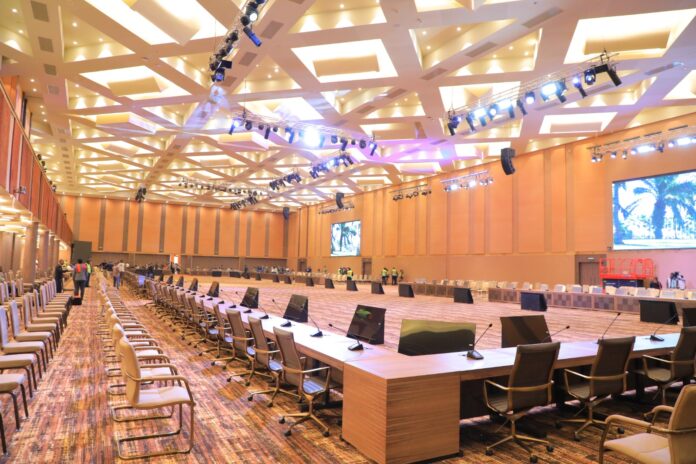
The Ministry of Energy and Mineral Development in partnership with Uganda Chamber of Mines and Petroleum and United Nations Development Programme today entered the second day of the 7th annual Oil and Gas Convention 2021.
The convention, which is taking place from 22nd – 23rd June, is being held under the theme, “Harnessing Opportunities In The Oil and Gas Sector post FID”.
The convention will also be addressed by President Yoweri Museveni later today.
The convention is a consultation and interaction seeking ways to enable Ugandans and Ugandan companies to tap into opportunities in the Oil and Gas Sector.
At the moment, several Ugandan companies have registered on the National Supplier Database (NSD) with the cumulative total number of companies qualified at 2,166 of which 1,591 are Ugandan companies.
The National Supplier Database is the first line for identification of subcontractors. The subcontractor tenders will be run in the media and online platforms.
“Prequalification is an ongoing process and has already started” Jason Williams, the Senior Director, EMEA said.
The Ministry is also facilitating registration of entities in the districts to register through on-site campaigns.
Kiryowa Kiwanuka, a Board Member, Petroleum Authority of Uganda (PAU) said that; “We are at a pivotal stage in the progression to first oil. Oil is a finite resource and therefore we need to manage the sector in a sustainable manner. I am committed & available to engage to ensure the country reaps the benefits.”
PAU monitors and regulates the upstream and midstream Petroleum sector in Uganda to create lasting value for society and a sound investment destination.
Hon. Ruth Nankabirwa, the Minister of Energy and Mineral Development said she’s committed to achieving the set targets and to do so in line with the NRM manifesto.

“I am energetic and committed to ensure the meet the targets set, in order to deliver services to the people. The opportunities and benefits in the oil sector are immense, we must deliver these in line with the NRM Manifesto,” Ruth Nankabirwa said.
On whether the ambitious targets for first oil will not lock out Ugandans, Alex Nyombi, the Director Development and Production, Petroleum Authority of Uganda (PAU) said;
“The delay has enabled Ugandan entities prepare to deliver on time and on budget in non-technical areas like camp management but also in technical areas like geotechnical studies”.

In addition, the Ministry urges Ugandan companies to enter partnerships in order to laverage huge capital contracts which they would otherwise not have the capacity to exploit on their own.
“The scale of the projects coming in the next phase is nothing like Uganda has ever seen. For example, the Tilenga EPC contract alone is approximately $2 billion, this means very few companies in Uganda have executed contracts of similar nature.”
“The only way, therefore, is to enter into partnerships to raise the required capacity, capital and share the risk burden or come in at subcontracting level.”
Companies aren’t the only entities poised to benefit from the oil and gas sector. According to the Rafael Guerithault, the Director Strategy and Marketing at Schlumberger, an Oilfield Technologies giant, the engineering company aims to also partner with two Universities in the country.
“Schlumberger aims, as part of their national content plan, to partner with atleast 2 universities, employ 50% female recruits, over 90% Ugandan personnel by 2025, spend USD 40 Million by 2025 on 500+ Ugandan suppliers and alliances for semi-skilled staff development.”
The Petroleum Authority of Uganda (PAU) announced that it is taking the following steps to facilitate constructive linkages between local players and the incoming contractors;
▶️Enforcing the law; Ugandan companies are given priority.
▶️If no Ugandan company has the capacity, then a joint venture and lastly a foreign company can be contracted where they subcontract Ugandan companies if the JV is not possible.
▶️Ring-fencing some contracts fenced for Ugandan and Ugandan companies, this will be a key requirement at TIER two where majority of Ugandan companies will come to supply.
▶️ Reviewing Bid Evaluation Reports (BERs) above $100,000. It’s through this process that the opportunities of sub-contracting or joint venture are identified.
▶️ Ensuring that the bidding process involves the national content proposals by all bidders which accounts for 10%. These proposals also give a clear picture of what will be subcontracted or performed in a JV.
▶️Holding several engagements such as National Content Conferences to bring local and international players together. The level one contractors will hold these conferences once contracts are signed.