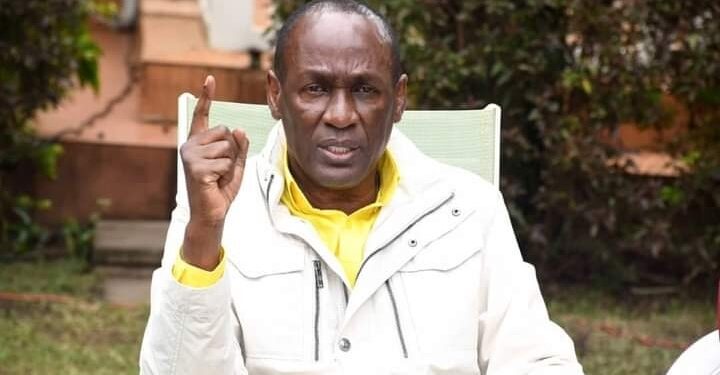
Capt. Mike Mukula has vowed to take legal steps against a media publication for misrepresenting his statements made at the recent inauguration of the Patriotic League of Uganda (PLU) in Kampala.
The Vice Chairman of NRM for Eastern Uganda responded assertively in a press briefing to allegations made by the Kampala Journal on social media, which misrepresented his speech to suggest he disparagingly referred to the Buganda community as “dogs” during the PLU event.
In his original speech, widely broadcasted across major media platforms, Mukula emphasized that the NRM government would resist transferring power to those "who do not have this country at heart," without attributing his comments to any specific ethnic group or individuals.
During the press conference, an irate Mukula announced his intention to pursue legal action and has sought intervention from the Police and the Uganda Communications Commission (UCC). "I have instructed lawyers and asked the Police and the Uganda Communications Commission (UCC) to take up this matter," he stated.
Mukula also seized the opportunity to highlight his deep-rooted connections and respect for the Buganda community, underscoring his roles within the Kingdom's hierarchy and his involvement in significant cultural events, including the King's coronation. "I want to inform my brothers and my in-laws, the people of Buganda, that I was raised well, I am an official in the Buganda Kingdom…I was even a part of the team that organized the King’s coronation," he shared.
He further reflected on his personal and professional life, demonstrating his respect and contributions to the Buganda Kingdom, such as launching a ferry named after Kabaka Ronald Muwenda Mutebi II on Lake Victoria.
Additionally, Mukula warned against the media's role in fueling tribal discord. Drawing from his harrowing experiences during the 1994 Rwandan genocide, he stressed the catastrophic consequences of tribalism. "Tribal politics is very dangerous," he remarked. Mukula recounted his involvement in rescue operations during the genocide, including a poignant memory of finding an infant attempting to nurse from its deceased mother, to illustrate the grave risks of tribal animosity.
Mukula's call to action highlights the critical need for political and media figures to exercise caution and responsibility in their discourse, emphasizing the potential of tribalism to irreversibly harm societal harmony and progress.