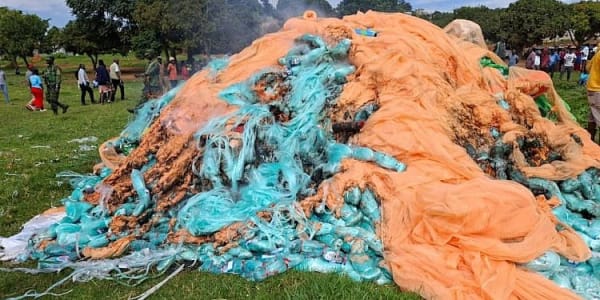
The Uganda investment authority (UIA) is supporting businesses that are willing or are already engaging in the manufacturing of alternative packaging materials. This is all in a bid to aid the government of Uganda to effect the ban on the use of plastic/polythene bags, locally known as Kavera.
While touring crane paper bags limited in Bweyogerere, the State Minister of Finance for Investment and Privatization, Evelyn Anite said the government has built enough capacity to manufacture paper packaging materials as opposed to the use of kaveera.
Anite, accompanied by Robert Mukiza, the Director General, UIA and Morrison Rwakakamba, the Board Chairperson, UIA, told journalists that the government will soon implement the total ban of use and manufacturing of polythene bags in the country.
“Our government policy of banning Kaveera is not going to be frustrated because we are protecting the environment. We will not leave our suppliers without any alternative packaging materials because they (manufacturers) have started manufacturing packaging materials other than kaveera (polythene bags),” Anite said.
The government, in its budget speech of 2007, banned the importation, use, and distribution of polythene bags of less than 30 microns.
However, there have been uncoordinated directives of implementing the law within the different government enforcing agencies, largely leaving the law on paper and the use of the Kaveera continuing to serve the interests of the public.
While top environment conservation agencies and civil society organizations have called upon the government to punish companies that have ignored the ban on single use plastics, not much has been achieved to this effect.
Mukiza says while there’s a law on the use of Kavera, he has called upon local investors who have invested in environmentally-friendly businesses to take advantage of the incentives at the UIA adding that acquisition of a license is now easy.
The previous ban on polythene has been opposed on various grounds. One, that it eases packaging for shoppers who claim that they see no suitable alternative. Second, that the manufacturers who had invested in the making of the bags would lose out and thirdly, that the ban would cause unemployment to the many people in the industry.
However, every argument must be weighed against the damage by the kavera on the environment, and how far it has become a menace in our daily lives.
Therefore, there’s a need for the government to continue sensitizing the public on the harmful effects of plastics and kavera on the environment.