EACOP Reaffirms Human Rights Commitment Amid Ongoing Protests
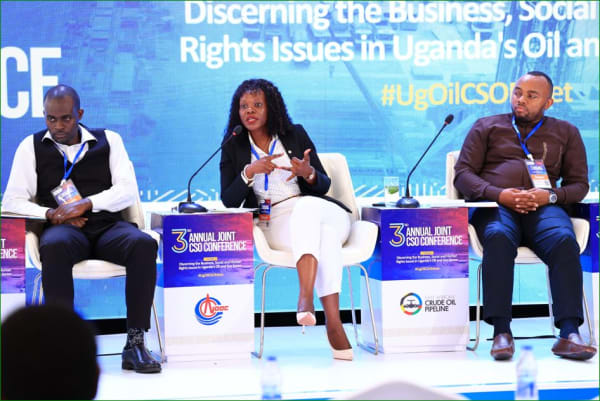
Civil Society Organisation (CSO) Conference on Oil and Gas
As fresh protests and community grievances continue to emerge around Uganda’s burgeoning oil and gas developments, the East African Crude Oil Pipeline (EACOP) Ltd has reiterated its firm commitment to respecting human rights and maintaining open dialogue with civil society and affected communities.
This assurance came during the recent Civil Society Organisation (CSO) Conference on Oil and Gas, organised by the Petroleum Authority of Uganda (PAU).
The annual forum, held under the theme “Discerning the Business, Social, and Human Rights Issues in Uganda’s Oil and Gas Sector,” brought together key stakeholders aiming to promote best practices in business ethics and human rights within the sector.
From Principles to Measurable Actions
Barbara Nakayenze, Human Rights Coordinator at EACOP, spoke on a panel outlining how the company is actively meeting its obligations under the United Nations Guiding Principles on Business and Human Rights (UNGPs). She emphasised that EACOP’s approach extends beyond mere aspirations, embedding concrete processes and measurable actions into its operations.
“We moved from principle to practice, and from intent to measurable responsible action,” Nakayenze explained. She referenced a Human Rights Impact Assessment (HRIA) conducted in 2018, followed by a Human Rights Due Diligence (HRDD) framework that identified nine key human rights issues along the pipeline corridor. Among these priorities were women’s rights, marine livelihoods, and the rights of contractor and supplier workers. Grievance mechanisms and access to information were identified as cross-cutting concerns addressed through institutional reforms.
Nakayenze stressed the importance of transparency and multi-stakeholder accountability. She pointed out that the HRDD report is publicly available on EACOP’s website, urging civil society to engage more proactively with the information. “Every year we come to this forum and say the same thing: the report is available. Yet very few people seem to have read it,” she noted, highlighting the gap between forum attendance and awareness of the report’s contents.
To foster inclusivity, EACOP has introduced various grievance platforms tailored to different groups, including community members, workers, and an anonymous whistleblowing tool called NAVICS. Nakayenze encouraged individuals hesitant to approach EACOP directly to use state institutions such as the Uganda Human Rights Commission or Tanzania’s Commission for Human Rights and Good Governance. “We understand that some civil society groups or individuals may not want to speak directly to us. That’s why we support alternative avenues for accountability,” she said.
Engagement, Challenges, and a Path Forward
Nakayenze acknowledged the vital role of human rights defenders and youth voices, affirming that protests and petitions—both local and international—are taken seriously. She shared that EACOP teams have met with protestors on-site, received petitions, and engaged in constructive dialogues to address concerns.
Her remarks reflected an openness to continuous improvement and innovation. “We’re not perfect,” she admitted, “but mistakes show that we are making progress. We’re open to new ways of engagement—please propose them.”
While her comments were met with appreciation, some civil society actors remained cautious, questioning the effectiveness of grievance channels and the accessibility of information, particularly for rural communities directly impacted by the project. Nonetheless, the session concluded with a tone of guarded optimism, with many agreeing that sustained dialogue and transparency remain critical to building trust in Uganda’s oil and gas sector.
As the EACOP project advances, attention turns to how these commitments translate into tangible improvements on the ground, and how civil society continues to respond in the evolving landscape.