DNA Test Settles Paul Kafeero Paternity Dispute; Only Four Children Confirmed
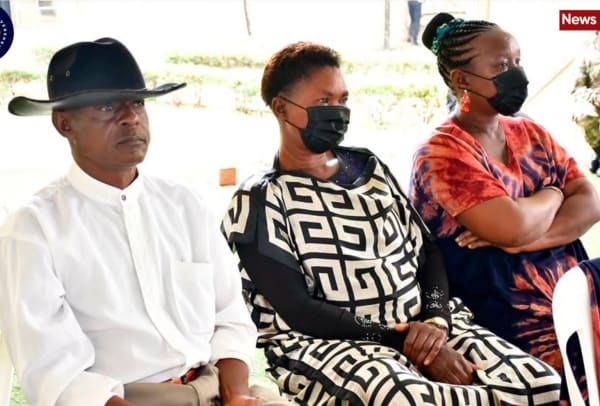
Paul Kafeero's family members
A long-running dispute over the biological children of the late Kadongo Kamu icon Paul Kafeero has finally been settled after DNA tests confirmed that only four of the 25 people who submitted samples are his biological children.
The findings were announced on Wednesday at the Uganda Police Headquarters in Naguru by officials from the Government Analytical Laboratory and the Uganda Police Forensic Services Laboratory.
The DNA tests were conducted after a court ordered the exhumation of Kafeero's remains to obtain reference samples for comparison with those of individuals claiming to be his children.
The four confirmed biological children are:
Thomas Kafeero
Simon Peter Kafeero
Benedicto Kafeero
Elizabeth Nagawa
The remaining 21 people who underwent testing were not identified as Kafeero's biological children.
Those who submitted DNA samples included Thomas Kafeero, Simon Peter Kafeero, John Kafeero, Benedicto Kafeero, Aroon Nagawa, Elizabeth Nagawa, Phillip, Tonny, John Mark, Meddi, Godfrey Muwanguzi, Ssendi Shafik, Katumba Eric, John Martin Kafeero, Paul Ssentongo, Kate Nalukwago, Margaret Nakafeero, Nagawa, Grace Nalukwago, Leticia Nalukwago, Rehema Namulindwa, Tana Birungio, Joan Mirembe, Noelena Ssali and Mukiibi Kafeero.
The exercise was overseen by Minister of Local Government Balaam Barugahara, who said he initiated the process while serving as Minister of Gender, Labour and Social Development.
The announcement sparked emotional scenes. Some of those present broke down in tears after learning the outcome, while relatives of the four confirmed children celebrated.
Kafeero's brother, Vincent Mende, thanked Barugahara for pursuing the matter.
"I thank Minister Balaam for the good job. I approached him on this matter and he took it up. Kafeero started his own burial ground. I have seen people upset about me, but this was a tough issue. He cannot rest in peace when his family is not at peace. I ask the children to be calm. We are not here to fight over the late Paul Kafeero’s properties but to bring together his real family," Mende said.
Family friend James Ssenkubuge urged those disappointed by the results to accept them peacefully.
"We are here for the good of Paul Kafeero. Those who are upset, I ask for calmness. We want him to rest in peace. This situation should also serve as a lesson to other men and families out there to make better preparations for your families before you die," he said.
Barugahara praised the police forensic team for completing the exercise and encouraged families to resolve paternity questions before they become legal disputes.
"I thank Uganda Police and their analytical lab for the work they have done.
"Paul Kafeero was a dear friend of mine. The kids who will be found to be Kafeero’s children, we are your uncles and we shall continue to support you.
"Even those who are not, we shall support you. There are development programmes at the Ministry of Gender.
"If you know you have more than one child, test them before you go to heaven. There are many labs. Get your kids tested so you don't leave it with the task of exhuming your body as we have done in this case.
"Samples of Kafeero will remain in the lab's database, and any child who comes later is free to get tested as well to confirm whether they are his biological child," he said.
Andrew K. Mubiru of the Uganda Police Forensic Services Laboratory said forensic experts carried out the DNA analysis after exhuming Kafeero's remains under a court order.
He said the exercise, supervised by Assistant Inspector of Police Dr Moses Byaruhanga, involved collecting samples from the left and right femoral bones, hair, jaw and skull.
Following the release of the results, Barugahara urged the four confirmed children to take responsibility for managing their father's estate.
Paul Kafeero, who died in 2007, is remembered as one of Uganda's greatest Kadongo Kamu musicians. The uncertainty surrounding his biological children remained unresolved for years before the courts authorised DNA testing to establish the truth.