
CRBC Moves to Restore Kole Access Roads as Tororo–Gulu Railway Targets January Operations
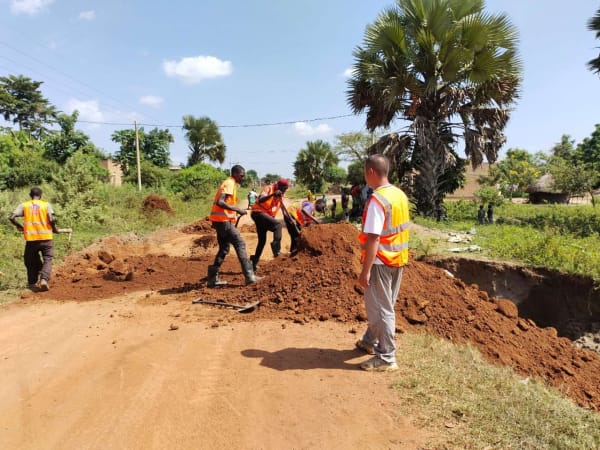
CRBC IS stepping in to address deteriorated community access roads in Kole District.
The rehabilitation of the Tororo–Gulu railway is moving beyond the restoration of tracks and railway infrastructure, with contractor China Road and Bridge Corporation (CRBC) stepping in to address deteriorated community access roads in Kole District.
The intervention comes as the 375-kilometre railway project approaches a critical stage, with the contractor targeting the resumption of train services to Gulu by early January.
During a joint field inspection involving CRBC engineers, Kole District Local Government engineers and representatives from the office of the area Member of Parliament, several road sections were identified as difficult or impassable.
The affected stretches included washed-out sections, flooded crossings and collapsed culverts that have disrupted movement within communities and complicated the transportation of construction materials, machinery and personnel to railway work sites.
Following the inspection, CRBC deployed an excavator, tipper trucks and a motor grader to restore access along the identified sections.
The works include filling washed-out areas with hardcore and murram, reinstating damaged crossings, reshaping road surfaces and clearing drainage channels to improve water flow.
Addressing a challenge affecting both the project and communities
Reliable access roads are essential to the completion of the railway rehabilitation. Poor feeder roads in parts of Kole have made it difficult to transport rails, ballast, machinery and workers, particularly during periods of heavy rainfall.
However, the challenge extends beyond construction activities.
Farmers, traders, boda-boda riders and school-going children also depend on the same roads for their daily activities. During the wet season, some routes become nearly impassable, affecting access to markets and essential social services.
By repairing the affected sections, CRBC is addressing a logistical challenge facing the railway project while providing relief to communities that depend on the roads.
At several work sites, excavators were seen spreading hardcore and murram to reinforce weak sections, while local workers engaged by the contractor undertook manual backfilling and levelling.
A motor grader was also deployed to reshape damaged road surfaces and restore motorable sections.
Residents gathered at some of the sites to observe the works, with the improvements expected to ease movement and access to services.
The intervention followed engagement between CRBC, district technical officials and the office of the area Member of Parliament to identify the most urgent community access challenges.
The joint inspection provided an opportunity for local leaders to highlight road sections requiring immediate attention and for the contractor to agree on priority areas.
Engagement meetings with district officials and community leaders have also helped identify local concerns and guide the contractor on where interventions are most urgently needed.
The use of local workers in the rehabilitation activities has further created opportunities for community participation in the project.
The Government of Uganda is funding the rehabilitation of the 375-kilometre Tororo–Gulu metre-gauge railway, which passes through Mbale, Kumi, Soroti and Lira before connecting to the Gulu Logistics Hub.
Uganda Railways Corporation is implementing the project under the Ministry of Works and Transport, with CRBC as the contractor. LEA Associates South Asia, working with Denmar Consulting, is supervising the works.
The rehabilitation covers drainage, earthworks, utility relocation, bridge repairs and track relaying.
The railway is expected to restore rail connectivity to Northern Uganda after the line remained largely inactive for about three decades.
Once operational, it is expected to provide an alternative for transporting goods, reduce pressure on road transport, lower cargo transportation costs and strengthen Uganda's trade links with South Sudan and the Democratic Republic of Congo through the Gulu Logistics Hub.
For businesses and communities along the railway corridor, the return of rail services could create new opportunities in trade, logistics and other economic activities.
CRBC has pledged to have trains running through to Gulu by early January, a milestone that would mark a significant step in restoring railway transport to Northern Uganda.
The ongoing access road works in Kole form part of the wider effort to address challenges affecting construction activities while responding to the needs of communities hosting the project.
As the rehabilitation advances, the restoration of the railway will be measured not only by the completion of tracks and railway infrastructure, but also by the extent to which improved connectivity supports businesses, communities and regional trade.