
By Andrew Kabeera
The future of financial inclusion in this country and across the world will depend squarely on how the financial industry can collect data from the millions of people who need financial services efficiently and effectively.
In the last year, we at PostBank have had the honour of supporting the government in disbursing money for the Parish Development Model (PDM). We have disbursed about Ushs 600 billion via our Wendi mobile wallet platform, and we are on track to disburse one trillion shillings by the end of the financial year.
That is all very well, and these monies have assisted thousands of families and enterprises around the country, but even more important are the learnings we have gained from the experience. These have brought new revelations and concretized our, and the industry’s, thinking about the future of financial inclusion and how Artificial Intelligence (AI) and machine learning will be key in this endeavour going forward.
For any country, especially developing ones like our own, financial inclusion is important, even critical, to mobilise our resources for growth and development.
At the heart of the government's PDM is a plan to improve the livelihoods of about 3.5 million households, or 17.5 million Ugandans, using the parish as the unit for planning, development, and implementation. The widespread adoption of the mobile phone in the country – about 33 million mobile phone users – means that technology can make this happen effectively and efficiently.
Partly in response to this challenge, we created the Wendi mobile wallet, meant to help clients save, borrow, and consume all other services the bank provides. More importantly, Wendi is serving as a data collection tool that will prove invaluable not only to the bank but to the economy as a whole.
We were pleasantly surprised to discover, contrary to initial expectations, that the adoption of technology is very high in the rural populations that PDM targets. Since we rolled out in 2023, we have logged in a million new accounts on the Wendi platform, which may not seem like much until you realise that the bank has barely 700,000 clients.
Of course, it helps that our platform works both with smartphones and with the USSD code that we use to send text messages, as barely a third of all mobile phone users have smartphones. This is a situation that will change quite quickly as the cost of smartphones falls, making them more affordable for people.
These new adopters of the technology are providing a lot of data that is moving planning decisions away from opinion and guesswork into the realm of fact, allowing us to have serious conversations and make more impactful decisions.
Our experience has also shown that meaningful and sustainable financial inclusion can only become a reality with the use of technology. People are not banking primarily because they have nothing or little to bank, but because banking, as we know it, is not convenient.
We have heard stories of village groups saving tens of millions in a hole in the ground, with ingenious ways of keeping it safe and secure from thieves. So, these people are not poor; it is just that they are not well integrated into the formal financial system, which would offer them more leverage. There are districts in this country without a branch, but there is no district, parish, or village where there is no mobile phone user.
While there is still a need for the human element in banking, the bank branch of the future will serve a different role. People may come to branches for access to technology, customer service, or mere human interaction, but the more mundane tasks of opening an account, depositing, and borrowing will very well be catered for by online platforms.
With the increased access to data that online financial platforms offer – and this is already happening – the integration of AI and machine learning will accelerate in coming years. People’s banking experiences will become so customised that customers will have totally different experiences.
Imagine you have a smartphone, and you upload various apps, and your neighbour has the exact same phone and uploads apps of their choice. At the end of it all, you will have the same phone but very different experiences. That is where the financial industry is heading.
For us at PostBank, it is quite exciting to experience that not only are more and more people getting into the money economy, but also, for the first time, we will have visibility of how the rural majority consume and, therefore, can make meaningful decisions that will positively impact their lives.
The possibilities are immense and transformational.
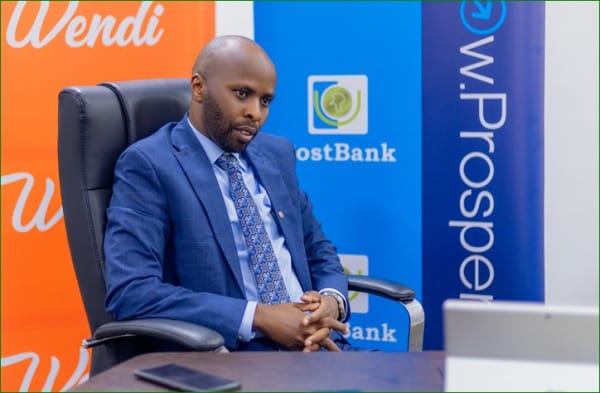
The author is the PostBank Executive Director and Chief Digital Financial Services Officer.