The Ministry of Agriculture, Animal Industry and Fisheries has revealed that it’s Agro-industrialization Programme, which was run under the National Development Plan 3 (NDP III), has achieved targets for 53 percent of the indicators used to monitor it in it’s first year of implementation alone.
The Agro-Industrialization Programme contributes to 10 outcomes which are monitored through 17 indicators.
The implementation of the Agro-industrialisation (AGI) Programme of the NDP III was undertaken by Government in Financial Year 2020/21 with the goal “to increase commercialization and competitiveness of agricultural production and agro-processing.”
The Programme comprises of 6 sub-programmes i.e.
Agricultural production and productivity.
Post-harvest handling and storage.
Agro-processing and value addition
Market Access and Competitiveness.
Agricultural Financing and
Institutional Strengthening and Coordination
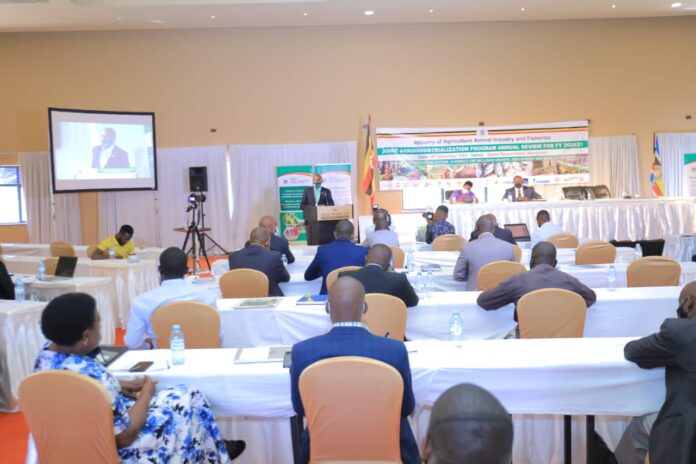
MAAIF commissioners, Civil society organizations and other stakeholders fully attended the conference to exchange ideas on the best direction the sector should take in the next financial year.
The theme of the day was; “Agro-industrialization- A vehicle for inclusive growth, empowerment and wealth creation”.H
The ceremony which took place in Munyonyo, was chaired by Hon. Frank Tumwebaze, Hon. Dr. Bright Rwamirama and Hon. Fred Bwino Kyakulaga.
Speaking at the event, Hon. Frank Tumwebaze, the Minister for Agriculture, Animal Industry and Fisheries, called for more organization of the stake holders in groups that meet regularly for better reporting at the end of the year.
“Let us organize the stakeholders according to working groups. These groups will have to meet regularly so that we report on where we are at the end of the year. We should do performance-based evaluations,” Tumwebaze said.
Hon Fred Bino said Government’s path of agro-industrialization is a commendable one as it provides Ugandans with the much needed jobs to improve their welfare.
“Agro-industrialisation is a quick win formidable strategy for Uganda to realize the much needed jobs for the youth and subsistence farming households, employment and wealth creation. This is because it has high multiplier effects with much added value to the agricultural outputs which would create jobs,” Bwino said.
At the event, different stake holders in the industry of Agriculture pledged to work together to achieve the NDP III goals in the coming financial year.
Implementation of the Agro-industrialisation program sub-programs.
Sub-programme 1 (Agricultural production and productivity) : The objective is to increase agricultural production and productivity.
Interventions:
1. These include setting up new and rehabilitating existing infrastructure for administration and agricultural research.
2. Developing and extending to value chain actors the demanded agricultural technologies for animal breeding, food and nutrition security and industry & Retooling public and private extension workers.
3. Availing quality critical inputs to farming households, setting up new and rehabilitating existing infrastructure for water for production & Controlling crop and animal pests, vectors and diseases.
Sub-programme 2 (Post-Harvest Handling and Storage): The objective of this sub-programme is to improve post-harvest handling and storage of agricultural products.
Interventions: Supporting cooperative societies, communities with cleaning, drying, grading and primary processing equipment and developing the capacity of cooperatives, communities, farmers and traders in post-harvest handling and storage.
Sub-programme 3 (Agro-processing and Value Addition): The objective is to increase processing and value addition of agricultural products.
Interventions: Revising existing industrial pollution guidelines, construction / equipping of planned tea factories, Supporting dairy cooperatives and farmers with value addition equipment and rehabilitating the absorbent cotton processing plant.
Sub-programme 4 (Market Access and Competitiveness): The objective of the sub-programme is to improve access to agricultural markets and increased competitiveness of agricultural products.
Interventions: Training farmers and manufacturers on best sanitary and phytosanitary management practices, equipping regional milk testing laboratories and constructing/renovating and equipping certification laboratories.
Sub-programme 5 (Agricultural financing): The objective of the sub-programme is to increase the mobilization, equitable access and utilization of agricultural finance.
Interventions: Out of 6 interventions for the NDP III duration, one intervention was planned for implementation in 2020/21. This is the capitalization of Uganda Development Bank and Microfinance Support Centre by Government.
Sub-programme 6 (Institutional strengthening and coordination): The objective is to establish, and/or strengthen a coordination mechanism of actors in the value chain and ensure that services and resources are delivered to facilitate the Agro-industrialization agenda.