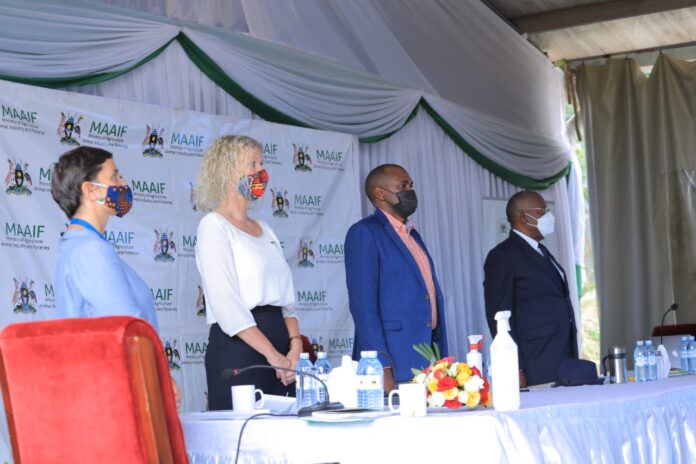
The Minister for Agriculture, Animal Industry and Fisheries, Hon. Frank Tumwebaze, hosted a trialogue session between the European Union and agriculture products expoters to Europe Market in line with the NDPIII Agro-Industrialization program objective of improved market access.
The European Union is a strategic destination for horticultural exports from Uganda’s farmers. The trialogue was a discussion involving three parties: Government of Uganda, the private sector and European Union in Uganda.
“Our Trialogue with EU, private sector, Ministry of Trade and farmer exporters is on at the Ministry of Agriculture. Our conversation is on what more needs to be done to our exports to sell more to EU market. We are talking standards, compliance, quality, quantity & what each actor needs to do,” Frank Tumwebaze announced.
“Through this trialogue, we must address the problem and focus on finding and implementing solutions. We must look into how we handle our agricultural products and how we control crop pests and diseases,” Hon. Frank Tumwebaze added.
Representative from the private sector, Mr. Hudda Mahmood delivered key notes highlighting the the need for collaboration with the public sector to boost exports in sectors like horticulture.
“As private sector, we have put in place associations and are working on an apex organization for horticultural product exporters. We would like to see increased coordination from the public sector,” said Mr. Hudda Mahmood, Private Sector Representative.
According to Mr. Hudda Mahmood, the Standard Operating Procedures developed by Government of Uganda through the Agriculture Ministry have enabled stakeholders to understand their respective roles and obligations.
“As private sector, we appreciate the commitment exhibited by Government so far. We have a work plan in place that was developed with Agriculture Ministry and the Office of the Prime Minister and Standard Operating Procedures developed with MAAIF,” Mr. Mahmood said.
Uganda was given 5 major recommendations based on observations by the European Union and these include:
1. Ensure that official checks are performed by staff who have appropriate level of technical information in line with EU Phytosanitary legislation.
2. Ensure that the production and official inspections of fruits of peppers complies with the chosen options as provided for in the EU legislation.
3. Ensure that official inspections and sampling rates of consignments of Roses (cut flowers) and fruits and vegetables achieves an appropriate level of confidence to assure pest freedom.
4. Ensure that the conditions at the packing houses and times for inspections at the airport are sufficient for inspecting each consignment fully in line with the Phytosanitary standards (ISMP 23).
5. Ensure that additional declarations and other requested information on the Phytosanitary certificates refer correctly as per the EU Phytosanitary legislation, especially in relation to Thaumatotibia leucotreta and Spodoptera frugiperda.